Custom Kimono Robes for Salons & Hair Stylists
Custom Kimono Robes for Salons and Hair Stylists
Few upgrades change how a salon feels as quickly as custom salon robes. Swapping thin disposable capes for branded kimono robes signals quality the moment a client sits down, and it puts your salon’s name on every mirror selfie. This guide covers how salons use custom robes, what they cost, and how to choose a style your clients and stylists will actually love.
Salon robes do double duty: they elevate the client experience and they market your brand. A well-chosen robe is one of the cheapest ways to look more premium than the shop down the street.
How salons use custom robes
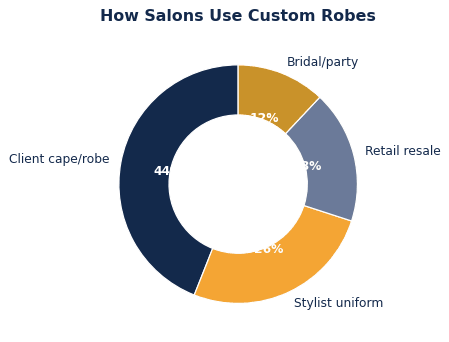
Most salons start with client robes or capes, then add stylist uniforms and retail pieces once they see the response. The breakdown below shows the common uses.
A matching set — client robe plus stylist robe in coordinated colors — makes the whole floor look intentional in photos and on social.
Fabric and style for salon use
Waffle and lightweight satin kimonos suit color and cut services because they are easy to launder and drape well; terry is plush but slower to dry. For high-turnover shops, choose a fabric that survives frequent washing and hides product stains.
Budgeting a salon order
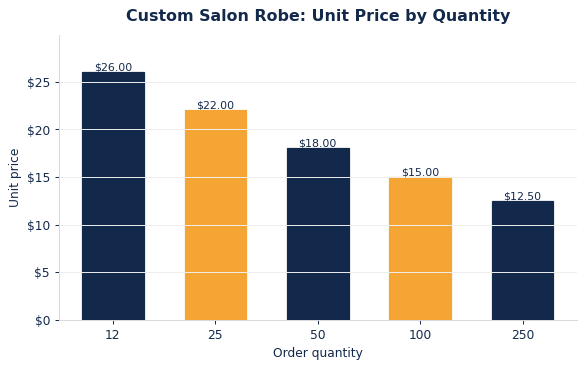
Unit price drops with volume, so a full-floor order costs far less per robe than a handful. The curve below helps you plan.
| Piece | Fabric pick | Note |
|---|---|---|
| Client robe | Waffle/satin | Easy launder |
| Stylist robe | Satin | On-brand look |
| Retail | Terry/satin | Higher margin |
Adding your logo? See our companion guide, our Monogramming Custom Robes: Thread, Placement & Font Guide. Explore our custom kimonos & robes or contact us to start your order.
Building a robe program that pays for itself
Custom salon robes are an investment, so it helps to think of them as a program rather than a one-time purchase. Client robes elevate the experience and show up in mirror selfies; stylist robes create a uniform, polished look on the floor; and a small retail selection lets clients buy the robe they just fell in love with, turning a cost center into a revenue line. Starting with client robes and adding stylist and retail pieces as demand proves out keeps the upfront outlay manageable while the program grows into itself.
The math is friendlier than many owners expect. A durable robe amortizes over hundreds of services, and even a modest retail markup on a few sold robes per month offsets a meaningful share of the order. When you frame robes as both an experience upgrade and a soft revenue stream, the decision shifts from whether you can afford them to how quickly they pay back.
Laundering and lifecycle for busy salons
In a high-turnover salon, robes live in the wash, so laundering realities should shape your fabric and color choices from the start. Waffle and lightweight satin dry faster and resist wrinkling, which keeps a rotation moving; heavy terry is plush but slower to dry and needs more stock to cover the same number of chairs. Mid-tone colors and patterns hide the occasional product mark better than pure white, extending the usable life of each robe between replacements.
Plan a rotation with enough robes to cover peak chairs plus a buffer in the wash, and set a simple retirement cadence so tired robes are pulled before they look worn to clients. Choosing colorfast fabrics and confirming wash instructions up front prevents fading and shrinkage that would otherwise shorten the program’s life and dull your brand.
Sizing an inclusive, comfortable range
A robe program only feels premium if every client is comfortable in it, which makes size range a branding decision as much as a practical one. Order a run weighted toward the middle sizes most clients wear, then add a few generous sizes so no one is squeezed into a robe that does not fit. A one-size-fits-most cut with a generous wrap and an adjustable tie covers a wide range gracefully and simplifies your inventory.
Communicating that you carry inclusive sizing — even just by having it visibly on hand — signals care and reflects well on the salon. It is a small detail that clients notice, and it removes an awkward moment at the chair that no amount of great styling fully makes up for.
Coordinating robes with your salon’s brand
Salon robes make the strongest impression when they look like a deliberate part of your space rather than a generic add-on. Pull your logo, colors, and even your signage typeface onto the robe so a client wrapped in it feels the same brand they see on the walls and in your app. A matching set — client and stylist robes in coordinated tones — makes the whole floor read as intentional in photos and on social, which is exactly where a salon earns new clients today.
Consistency also compounds over time. When every robe, towel, and cape shares a palette and a clean logo treatment, your salon looks established and considered, and that perceived quality supports premium pricing. Keeping the branding restrained — one tasteful logo or monogram rather than an all-over print — reads more upscale and keeps the robe wearable enough that retail clients actually want to take one home.
Common questions about custom salon robes
What fabric is best for salon robes?
Waffle and lightweight satin are popular for color and cut services because they launder easily, dry quickly, and drape well. Terry is plush but slower to dry, so it needs more stock to keep a rotation moving in a busy salon.
How many robes should a salon order?
Order enough to cover your peak number of chairs plus a buffer in the wash, typically a couple of robes per chair. Ordering the full run at once lowers the per-robe cost and keeps colors and branding consistent across the set.
Can salon robes generate revenue?
Yes. A small retail selection lets clients buy the robe they experienced, and even a few sales a month offset a share of the order. Framing robes as both an experience upgrade and a soft revenue stream improves the return.
How should salon robes be branded?
A tasteful embroidered logo or monogram in your salon colors reads premium without looking like merch. Keep placement consistent across client and stylist robes so the whole floor looks like one coordinated brand in photos and in person.
How long do salon robes last with frequent washing?
Colorfast, quick-drying fabrics like waffle and satin hold up well through frequent laundering, typically lasting many months to a couple of years in steady rotation. Retire tired robes before they look worn to clients, and keep enough stock that no single robe is overused between washes. Washing in cool water and skipping high heat in the dryer further protects the color and fibers over time.
Upgrading your salon’s client experience?
We’ll match robe fabric, fit, and branding to your salon and budget.
Get a QuoteCustom Kimono Robes for Salons and Hair Stylists
Few upgrades change how a salon feels as quickly as custom salon robes. Swapping thin disposable capes for branded kimono robes signals quality the moment a client sits down, and it puts your salon’s name on every mirror selfie. This guide covers how salons use custom robes, what they cost, and how to choose a style your clients and stylists will actually love.
Salon robes do double duty: they elevate the client experience and they market your brand. A well-chosen robe is one of the cheapest ways to look more premium than the shop down the street.
How salons use custom robes
Most salons start with client robes or capes, then add stylist uniforms and retail pieces once they see the response. The breakdown below shows the common uses.
A matching set — client robe plus stylist robe in coordinated colors — makes the whole floor look intentional in photos and on social.
Fabric and style for salon use
Waffle and lightweight satin kimonos suit color and cut services because they are easy to launder and drape well; terry is plush but slower to dry. For high-turnover shops, choose a fabric that survives frequent washing and hides product stains.
Budgeting a salon order
Unit price drops with volume, so a full-floor order costs far less per robe than a handful. The curve below helps you plan.
| Piece | Fabric pick | Note |
|---|---|---|
| Client robe | Waffle/satin | Easy launder |
| Stylist robe | Satin | On-brand look |
| Retail | Terry/satin | Higher margin |
Adding your logo? See our companion guide, our Monogramming Custom Robes: Thread, Placement & Font Guide. Explore our custom kimonos & robes or contact us to start your order.
Building a robe program that pays for itself
Custom salon robes are an investment, so it helps to think of them as a program rather than a one-time purchase. Client robes elevate the experience and show up in mirror selfies; stylist robes create a uniform, polished look on the floor; and a small retail selection lets clients buy the robe they just fell in love with, turning a cost center into a revenue line. Starting with client robes and adding stylist and retail pieces as demand proves out keeps the upfront outlay manageable while the program grows into itself.
The math is friendlier than many owners expect. A durable robe amortizes over hundreds of services, and even a modest retail markup on a few sold robes per month offsets a meaningful share of the order. When you frame robes as both an experience upgrade and a soft revenue stream, the decision shifts from whether you can afford them to how quickly they pay back.
Laundering and lifecycle for busy salons
In a high-turnover salon, robes live in the wash, so laundering realities should shape your fabric and color choices from the start. Waffle and lightweight satin dry faster and resist wrinkling, which keeps a rotation moving; heavy terry is plush but slower to dry and needs more stock to cover the same number of chairs. Mid-tone colors and patterns hide the occasional product mark better than pure white, extending the usable life of each robe between replacements.
Plan a rotation with enough robes to cover peak chairs plus a buffer in the wash, and set a simple retirement cadence so tired robes are pulled before they look worn to clients. Choosing colorfast fabrics and confirming wash instructions up front prevents fading and shrinkage that would otherwise shorten the program’s life and dull your brand.
Sizing an inclusive, comfortable range
A robe program only feels premium if every client is comfortable in it, which makes size range a branding decision as much as a practical one. Order a run weighted toward the middle sizes most clients wear, then add a few generous sizes so no one is squeezed into a robe that does not fit. A one-size-fits-most cut with a generous wrap and an adjustable tie covers a wide range gracefully and simplifies your inventory.
Communicating that you carry inclusive sizing — even just by having it visibly on hand — signals care and reflects well on the salon. It is a small detail that clients notice, and it removes an awkward moment at the chair that no amount of great styling fully makes up for.
Coordinating robes with your salon’s brand
Salon robes make the strongest impression when they look like a deliberate part of your space rather than a generic add-on. Pull your logo, colors, and even your signage typeface onto the robe so a client wrapped in it feels the same brand they see on the walls and in your app. A matching set — client and stylist robes in coordinated tones — makes the whole floor read as intentional in photos and on social, which is exactly where a salon earns new clients today.
Consistency also compounds over time. When every robe, towel, and cape shares a palette and a clean logo treatment, your salon looks established and considered, and that perceived quality supports premium pricing. Keeping the branding restrained — one tasteful logo or monogram rather than an all-over print — reads more upscale and keeps the robe wearable enough that retail clients actually want to take one home.
Common questions about custom salon robes
What fabric is best for salon robes?
Waffle and lightweight satin are popular for color and cut services because they launder easily, dry quickly, and drape well. Terry is plush but slower to dry, so it needs more stock to keep a rotation moving in a busy salon.
How many robes should a salon order?
Order enough to cover your peak number of chairs plus a buffer in the wash, typically a couple of robes per chair. Ordering the full run at once lowers the per-robe cost and keeps colors and branding consistent across the set.
Can salon robes generate revenue?
Yes. A small retail selection lets clients buy the robe they experienced, and even a few sales a month offset a share of the order. Framing robes as both an experience upgrade and a soft revenue stream improves the return.
How should salon robes be branded?
A tasteful embroidered logo or monogram in your salon colors reads premium without looking like merch. Keep placement consistent across client and stylist robes so the whole floor looks like one coordinated brand in photos and in person.
How long do salon robes last with frequent washing?
Colorfast, quick-drying fabrics like waffle and satin hold up well through frequent laundering, typically lasting many months to a couple of years in steady rotation. Retire tired robes before they look worn to clients, and keep enough stock that no single robe is overused between washes. Washing in cool water and skipping high heat in the dryer further protects the color and fibers over time.
Upgrading your salon’s client experience?
We’ll match robe fabric, fit, and branding to your salon and budget.
Get a Quote