Hotel & Spa Robe Programs: Choosing Hotel Robes Guests Remember
Ask frequent travelers what they remember about a great stay and hotel robes come up more often than the lobby art. The robe is the one amenity guests wear, photograph, and occasionally try to take home — which makes a robe program a branding decision disguised as a linen decision. But running hotel robes at property scale is a different problem from picking a nice bathrobe: it is about par levels, laundering economics, a sizing mix that fits every guest, and embroidery that survives two hundred wash cycles. This guide covers how to build a robe program that delights guests without wrecking the laundry budget.
Start with the Program, Not the Robe
A robe program has four moving parts: the robe spec, the par level (how many robes you stock per room), the laundering loop, and the replacement cycle. Properties that buy beautiful robes without planning the other three end up with damp robes at turnover, gray collars by month six, and a housekeeping team improvising. Decide up front who gets robes (all rooms, suites only, spa guests), how they are presented (closet hook, ribbon-tied on the bed, spa locker), and who launders them (in-house OPL or a commercial service) — every downstream spec follows from those answers.
Par Levels: The Number Nobody Gets Right
The industry shorthand is a par of three per robe slot: one in the room, one in the wash, one on the shelf. In practice the right number varies by property type and laundry turnaround. A resort spa with same-day laundering can run leaner; a city hotel sending linens out on a 48-hour loop cannot.
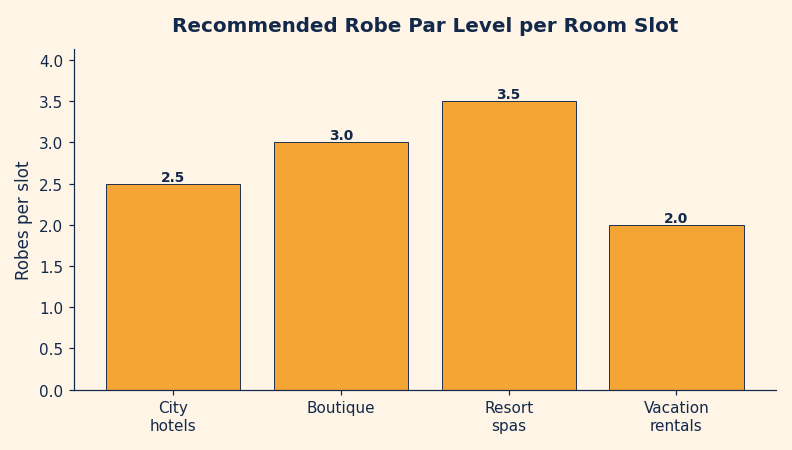
Under-parring is the most common failure: a sold-out weekend plus a slow laundry day equals rooms without robes, and that shows up in reviews with surprising speed. Over-parring merely ties up shelf space and capital, which is the cheaper mistake.
Waffle vs Terry in Bulk: The Real Trade-offs
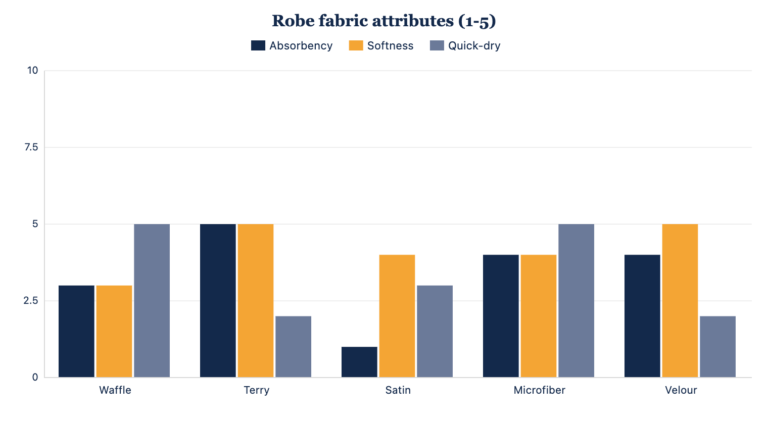
The waffle-versus-terry decision changes at scale because laundering economics dominate. Terry (looped cotton, 400–550 GSM) is the plush spa classic — absorbent, warm, and heavy. That weight costs money every single wash cycle: longer dry times, more machine capacity, higher energy per load. Waffle weave (diamond-pique cotton, 180–280 GSM) dries fast, packs three-to-one against terry on a shelf, and reads as modern and clean, but feels lighter than luxury to some guests. Microfiber-lined hybrids split the difference with a plush interior and a lighter shell.
| Factor | Terry (450 GSM) | Waffle (230 GSM) | Hybrid (waffle shell / lined) |
|---|---|---|---|
| Guest perception | Plush, classic spa | Light, modern | Premium, boutique |
| Dry time per load | Long | Short (≈40% less) | Medium |
| Shelf space per robe | High | Low | Medium |
| Typical bulk cost (200+ units) | $26–$38 | $16–$24 | $28–$42 |
| Typical service life | 18–30 months | 24–36 months | 18–30 months |
| Best fit | Resort spas, winter markets | Warm climates, city hotels | Boutique & lifestyle brands |
Many programs now run seasonal or dual programs: terry in the spa, waffle in guest rooms, which also gives the spa upsell a tactile difference guests can feel.
The Sizing Mix That Fits Every Guest
One-size-fits-all robes fit almost nobody well, and guests notice instantly. A workable program stocks two or three sizes. For a typical 100-robe order, the mix that minimizes bare-hook complaints is roughly 15 percent S/M, 60 percent L/XL, and 25 percent 2XL/3XL — skewed larger than apparel norms because robes are worn over sleepwear and guests strongly prefer roomy to snug. Kimono-style cuts with a generous wrap and an adjustable belt forgive more body types than shawl-collar cuts, which is one reason kimono robes have become the boutique default.
Embroidery and Branding That Survives the Laundry
Logo placement is where branding meets durability. Chest-left monograms in a single thread color survive commercial laundering far better than large multi-color designs, and tone-on-tone embroidery — cream on white, navy on navy — reads as quiet luxury while hiding minor wash wear. Specify polyester embroidery thread rather than rayon; it holds color through hot-wash cycles and chlorine-based sanitizers. Avoid printed logos on any robe that will see commercial laundering — they crack by cycle fifty. If robes are also sold in the gift shop (a meaningful revenue line at resort spas), add a woven side-seam label with size and care info so retail units are self-explanatory.
Laundering Economics and Replacement Cycles
Every robe in the program is a recurring cost, not a one-time purchase. The chart below models total cost per robe-year for the two main fabrics, including purchase amortization and laundering.
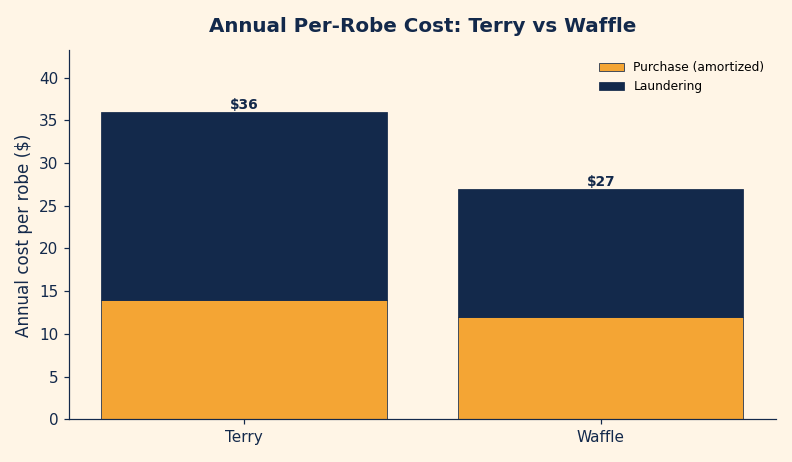
Plan replacement at 18–36 months depending on fabric and wash chemistry, and retire robes on a rolling schedule rather than all at once — a program that replaces 4–5 percent of stock monthly never has a visibly tired robe in circulation. Track retirement reasons for a quarter: if collar graying leads, adjust wash temperature; if seam failures lead, revisit the spec before reordering.
Rolling It Out
Order a sample run of a dozen robes, put them through twenty commercial wash cycles, and only then commit the full program — the difference between showroom feel and cycle-twenty feel is the whole game. If your property also hosts weddings and group getaways, robes double as retail and event inventory; our guide to bachelorette party robes and kimonos shows what that guest segment looks for, from personalization to photo-ready colors.
Read more about our custom robe production, browse other guides on the blog, or see fabrics and styles on our homepage.
Build a Robe Program Guests Talk About
Tell us your room count, laundry setup, and brand palette — we’ll spec fabrics, sizing mix, and embroidery, with wash-tested samples before you commit.
Get a QuoteWin Free Stuff
Enter below for a chance to win plus receive 10% off your first order.
🎉 You are in!
Check your email for your 10% off code. Good luck!